A cloudy drum sample and a clear raw material that hazes after fragrance addition may look alike in the final beaker. They belong to different investigations. Keep the samples separate long enough to find where the first visible change occurred.
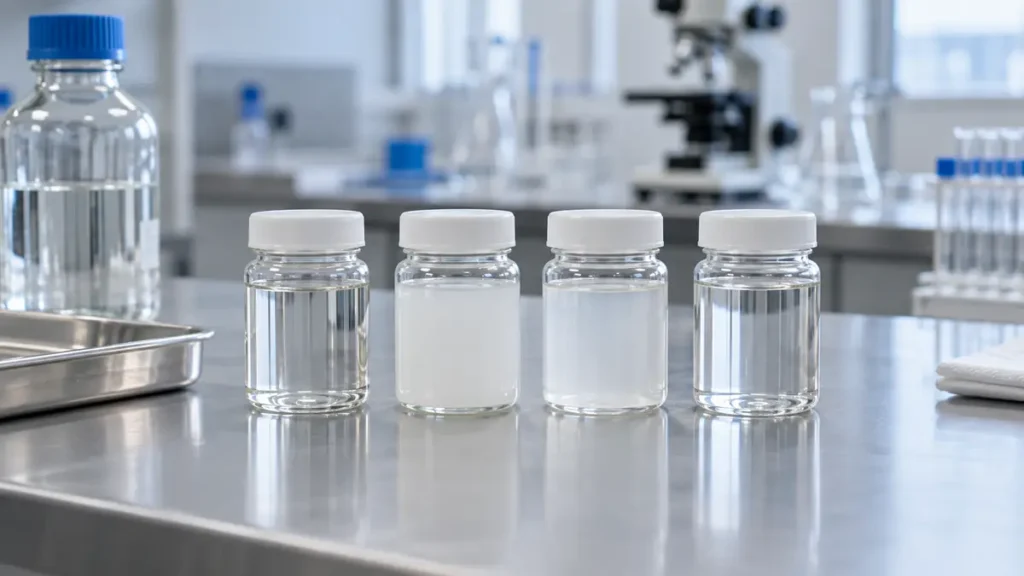
The quickest way to lose useful evidence is to warm, filter or adjust the only sample before documenting it. Photograph the sample against the same background as a known reference. Record temperature, sample depth, rest time and whether material has settled. Then retain an untouched portion.
Next, locate the change on a short timeline. Did the incoming KWCG-25 already look cloudy? Did its appearance change after controlled conditioning? Was the surfactant base clear before the late additions? Did haze appear immediately after one addition or only after standing? Those answers determine whether the first investigation belongs with storage and transport, the raw-material review or the finished formula.
Checkpoint 1Incoming container or retained raw-material sample
Checkpoint 2Conditioned sample at a defined temperature and time
Checkpoint 3Cleanser base before fragrance, preservative and final electrolyte
Checkpoint 4Finished formula after each controlled addition and rest period
Diagnostic sign: If the retained raw material is clear but the finished formula turns hazy, repeating a raw-material warming step will not identify the formulation trigger. Split the base and challenge the likely additions separately.
Low temperature is a testable branch, not an automatic explanation
Ionic surfactants can show temperature-dependent solubility and phase behavior. Recent research on N-acyl glutamate surfactants reports that their critical micelle temperature can depend on pH, instantaneous composition and thermal history. That work concerns studied model materials, not an INNO KWCG-25 storage trial, but it explains why one cold sample and one warmed sample should be compared under defined conditions. See the study on dynamic critical micelle temperature.
Do not assume that every cold-looking sample will clear after warming, or that clearing proves the material is ready for use. Follow the current TDS and the site’s approved conditioning procedure. Record the starting temperature, conditioning temperature, time, mixing or inversion method and appearance after the sample returns to the specified observation condition. If no current product instruction defines those conditions, request one rather than creating a universal recovery cycle.
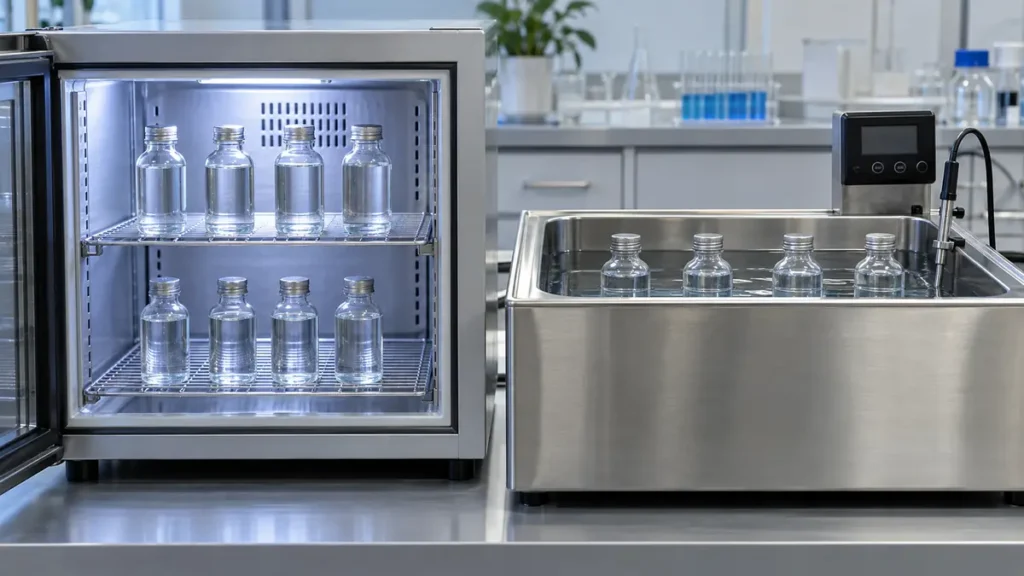
A conditioning result can lead to three different decisions. Full recovery under the approved condition supports a temperature-related branch, subject to the product specification and site review. Partial recovery calls for more time-point evidence or supplier input. No recovery shifts attention toward the lot, contamination, container history or a different phase change. None of these observations alone proves that a batch meets its release requirements.
Fragrance haze starts with a solubilization question
Fragrance is a mixture of molecules with different polarity and affinity for micelles. A surfactant base may solubilize one fragrance composition and turn cloudy with another at the same use level. Research comparing perfume compounds in pure and mixed surfactant micelles found that solubilization did not follow a simple additive rule across the tested systems. The materials in that study were not cocoyl glutamates, so the practical lesson is to test the actual fragrance in the actual base. The Journal of Colloid and Interface Science paper describes the measured partition behavior.
Use a retained clear base. Add the exact fragrance at the intended level and through the intended premix or sequence. Keep a control without fragrance. Observe both at the same temperature immediately after mixing and after the project’s defined rest period. If haze appears only in the fragrance sample, the next work belongs to the fragrance loading, solubilization route and complete surfactant balance. It is not evidence that the raw KWCG-25 is cloudy.
Preservative compatibility can change with the whole mixture
A preservative may be water-soluble on its own yet behave differently in a surfactant system. One small-angle X-ray scattering study found micelle formation, turbidity and phase separation in specific mixtures of poloxamer 188 with phenol and benzyl alcohol. This pharmaceutical model does not predict a personal-care cleanser, but it demonstrates why single-ingredient solubility cannot settle mixture compatibility. See the preservative and surfactant phase-behavior study.
Test the complete preservative blend, including its carrier, at the intended level. Compare a preservative-free base and a matched preserved sample. If the formula also contains fragrance, prepare separate fragrance-only, preservative-only and combined samples. A combined sample can fail even when both single additions look clear.
Electrolytes can alter the structure behind clarity
Electrolytes do more than raise a conductivity reading. They can screen electrostatic repulsion and change how charged surfactant assemblies pack. In a model alpha-gel containing disodium N-dodecanoylglutamate and a long-chain alcohol, changing sodium chloride altered lamellar spacing and rheology. That is not a clear-cleanser result for KWCG-25, but it is good reason to inventory every intentional and carried-in electrolyte before adjusting the batch. The study abstract is available through PubMed.
Inventory added sodium chloride along with acids, bases, buffers, botanical extracts and preservative carriers that contribute ions or change pH. Then run a small addition series around the actual formula. A single high-salt challenge may show that the system can be made cloudy, but it will not locate the operating boundary.
A five-sample screen usually tells more than one adjusted beaker
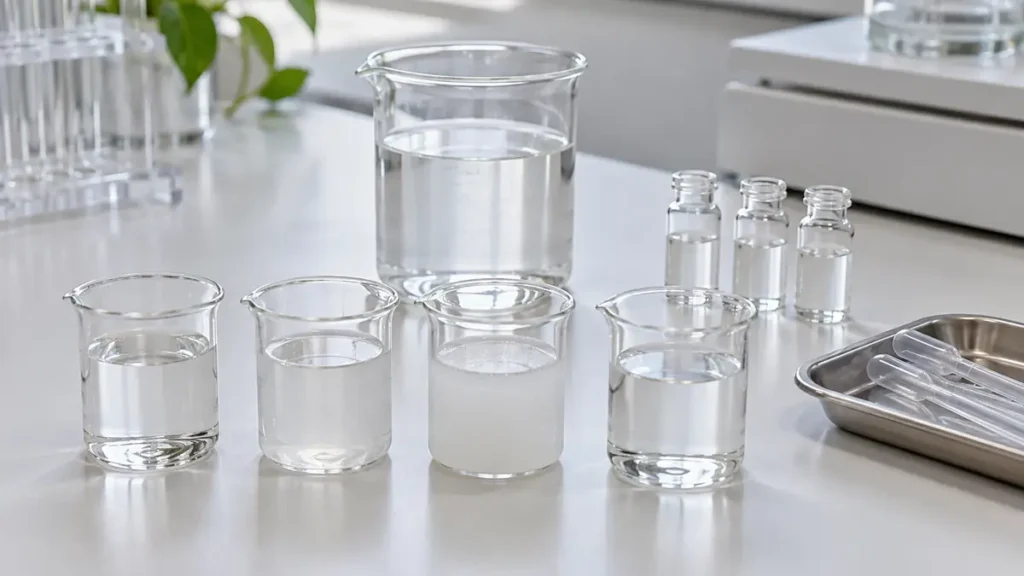
| Sample | Change from the clear base | What the result can show |
|---|---|---|
| Control | No late addition | Whether the base remains clear over the same observation period |
| Fragrance | Actual fragrance and intended addition route | Whether haze follows fragrance incorporation |
| Preservative | Complete preservative system and carrier | Whether the preservation package changes appearance |
| Electrolyte | Defined level of the actual electrolyte input | Whether ionic loading shifts clarity under the test conditions |
| Combined | All intended late additions in the production sequence | Whether an interaction appears only in the complete formula |
Measure pH and temperature for every sample. Use the same vessel, mixing energy, addition time and rest period. View the samples through the same path length against both light and dark backgrounds. If the formula is naturally colored, instrumental turbidity or a qualified visual standard may be more reliable than casual inspection.
What INNO’s current KWCG-25 listing establishes
INNO KWCG-25 is currently listed as a pale yellow or colorless transparent liquid. Its listed composition is 75 percent water, 20 percent Disodium Cocoyl Glutamate and 5 percent Sodium Cocoyl Glutamate. The standard pack is 200 kg.
Those details provide the comparison point for an incoming sample. They do not identify the cause of every cloudy observation and do not replace the current TDS, lot COA, storage history or a formulation challenge. If the unopened or properly sampled material differs from the agreed appearance, retain the lot number, container position and sampling method before contacting the supplier.
Hold the conclusion: Filtering a sample, warming it without a defined procedure or adding solubilizer before documentation may improve appearance while making the original cause harder to recover.
Frequently asked questions
Can cloudy KWCG-25 simply be warmed and used?
Only after following the current product instruction and confirming that the conditioned material meets the agreed appearance and quality requirements.
Keep an untreated sample and document the conditioning history. Clearing after warming is evidence about temperature response, not automatic release approval.
Does cloudiness mean microbial contamination?
No. Haze has several possible physical and formulation causes, and appearance alone cannot confirm or exclude microbial contamination.
Use the site’s approved sampling and microbiological investigation when contamination is suspected. Do not infer microbiological status from a visual comparison.
Should a cloudy liquid be filtered before formulation?
Do not filter it as a routine fix until the source of the haze and the effect on composition have been evaluated.
Filtration can remove evidence and may change the material. Retain the original sample and follow the deviation or supplier-review procedure.
Why is the raw material clear but the finished cleanser cloudy?
The trigger probably appears after incorporation, so test fragrance, preservative, electrolyte and pH changes in separate matched samples.
Include one combined sample because two individually clear additions can still interact in the complete formula.
What should we send when asking INNO to review the issue?
Send the lot number, sample photos, storage temperatures and times, conditioning history, formula sequence, pH and the point when haze first appeared.
If the raw material is clear, also include fragrance, preservative and electrolyte challenge results from one retained base.
Locate the first cloudy checkpoint
Send INNO the KWCG-25 lot, storage and conditioning history, matched photos, formulation sequence and split-sample results. A clear timeline helps separate a raw-material question from a formula interaction.