A dry raft, a soft surface island and a submerged lump can look like the same powder problem from across the vessel. They are not the same observation, and immediately increasing mixer speed can erase useful evidence.

When Sodium Cocoyl Glutamate powder does not disperse as expected, the most valuable action is often a short pause. Note when the symptom appeared, where it sits and whether it breaks with light pressure. A photograph taken at the time of failure is more useful than a later statement that the batch was simply lumpy.
Powder incorporation has several steps. Particles first meet the liquid, become wetted, move below the surface, separate from neighboring particles and distribute through the batch. A review of water-soluble powder reconstitution divides the process into wetting, sinking or immersion, disintegration and dissolution. Its examples are mainly food powders, not KWCG-95, so it should be used as a diagnostic model rather than a product recipe. See the review in Powder Technology.
First rule: Name the symptom before choosing the remedy. A powder that never enters the liquid points to a different process stage from a wet clump that circulates for a long time.
Make a 60-second observation record
Capture the batch state before changing speed, temperature or addition rate. Record the following:
When At first contact, halfway through charging, after the final addition, or only after the batch stands?
Where On the surface, at the wall, below the feed point, near the bottom, in a recirculation sample, or only in the final outlet?
How Dry and dusty, wet outside, rubbery, soft and breakable, hard, foamy, or visually uniform but different between samples?
Add the batch size, liquid level, equipment, temperature, ingredient order, feed duration and any interruptions. If the problem appeared after a process change, identify the last condition that was different. This record makes a controlled comparison possible.
Symptom 1: dry powder floats as a raft
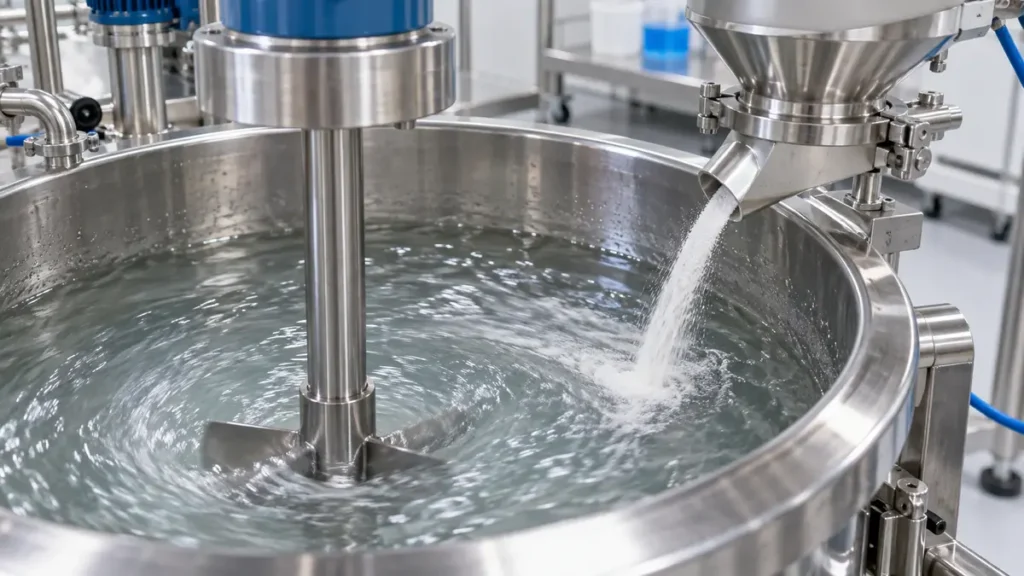
A dry floating layer shows that powder is arriving faster than the surface flow can wet and carry it into the bulk, or that the feed point is outside an effective entry zone. The vessel can have strong visible motion while the powder remains stranded at the wall or rides around the edge of a vortex.
Check whether each small portion disappears before the next arrives. Watch the actual landing point as the liquid level changes. Confirm that an extraction hood or feeder is not redirecting the powder stream away from the intended zone. Do not treat a deeper vortex as the automatic answer, because a vortex can also pull air into the batch.
Symptom 2: wet islands form on the surface
Surface islands usually mean that part of the powder has contacted liquid but has not been separated and drawn into the bulk. Local overfeeding is one possible cause. Another is repeated addition onto material that is already floating. If the outside of a group wets before liquid reaches the center, the group can become harder to disperse.
General powder-dispersion literature separates wetting from breaking wetted clumps, which is why one process change may improve entry but not finish deagglomeration. The Wiley overview of powder dispersion in liquids provides that framework. It does not establish a KWCG-95 mixing setting.
Symptom 3: soft clumps circulate below the surface
A submerged clump has passed the entry step. Now inspect its physical state. Remove a representative sample using the plant’s safe sampling procedure. Does the clump smear, split easily, release dry powder when opened, or remain firm? The answer helps separate incomplete internal wetting from a bulk-mixing problem.
Equipment suppliers sometimes describe a hydrated outer layer around dry powder in gum and thickener systems. That mechanism may explain some materials, but it should not be assigned to KWCG-95 without direct evidence. Use the break-open observation instead of naming a mechanism from appearance alone. The ROSS discussion of fish-eye formation is useful background for why bench addition behavior may not transfer directly to production, but its examples are not cocoyl glutamate test results.
Symptom 4: the batch looks uniform, but samples disagree
Long mixing with inconsistent samples points beyond the feed point. The vessel may have zones that exchange slowly, especially as liquid level or viscosity changes. A sample from the surface can look acceptable while an outlet or recirculation sample still contains concentrated material.
Take samples from agreed locations at defined intervals. Label each with location, time, temperature and batch stage. Compare appearance and relevant process checks using one method. If differences persist, review impeller position, liquid height, baffles and the recirculation path before extending mixing again.
Symptom 5: foam makes the dispersion impossible to read
Air entrainment can hide floating solids and make samples look less uniform than the liquid phase actually is. Check whether the powder addition or mixer setting created a deep vortex, splashing return or free-falling liquid stream. Record foam height separately from powder observations.
Do not add a defoamer simply to clarify the diagnosis unless it is already part of the approved formula and sequence. A new ingredient introduces another variable. First correct the observation and compare a sample after a defined rest or approved de-aeration step.
Change one variable at a time
| Controlled test | Question it answers | Keep fixed |
|---|---|---|
| Lower or staged feed rate | Is addition outrunning local wetting and removal? | Total formula, entry point, equipment and temperature |
| Move the entry point | Does powder land in a zone that carries it below the surface? | Feed rate, mixer setting and batch stage |
| Change mixing intensity within approved limits | Is bulk turnover or local deagglomeration limiting? | Feed rate, temperature and addition position |
| Compare one controlled liquid temperature | Does temperature alter wetting or dissolution behavior in this formula? | All other process conditions and measurement time |
| Compare water or pH conditions | Is the symptom associated with a defined chemical condition? | Powder lot, equipment and addition method |
Temperature, pH and water composition can influence a surfactant system, but a clump does not prove which variable is responsible. Do not jump from one failed batch to a general claim about hard water, ionic strength or a required temperature. Run a split comparison with one documented change.
Avoid an improvised rescue recipe. Before adding more water, changing pH or applying higher shear, confirm the symptom and evaluate how the change affects the complete formula, equipment limits and release criteria.
What the current INNO grade information tells you
INNO KWCG-95 is currently listed as Sodium Cocoyl Glutamate, CAS 68187-32-6, supplied as a white solid powder with 93.5 to 100 percent listed content. Its standard pack is 15 kg. These facts identify the material and supply form. They do not establish one universal dispersion temperature, addition rate, shear setting or hydration time.
INNO also lists KWCG-25 as a pale yellow or colorless transparent liquid containing 75 percent water, 20 percent Disodium Cocoyl Glutamate and 5 percent Sodium Cocoyl Glutamate. It can be considered when a project is evaluating a liquid feed route, but it is not a drop-in remedy for a failed KWCG-95 process. The composition, water contribution and formulation basis differ.
If clumping appears in only one batch, retain the lot details and compare the current certificate and incoming inspection with prior accepted material. Keep formulation, storage and process questions separate until evidence connects them.
Build a small troubleshooting screen

Use the smallest representative setup that reproduces the symptom. Prepare a control under the failed conditions, then change one factor in each comparison. Photograph samples at equal times and record the same observations. If the small setup cannot reproduce the production problem, that is evidence that vessel geometry, feed system or scale may be part of the cause.
End the screen with a decision. A result can support a revised feed rate, entry point, batch stage or equipment review. It can also show that more product or water-quality evidence is needed. What it should not produce is a list of simultaneous changes that cannot be traced to the improvement.
Frequently asked questions
Do clumps mean the KWCG-95 is expired or off specification?
Not by themselves. Clumps can arise from storage, charging, wetting, mixing or formula conditions, so retain the lot evidence and inspect the process.
Compare the current certificate, package condition and incoming inspection with accepted lots. Do not assign a raw-material cause until the process evidence supports it.
Will hotter water always solve Sodium Cocoyl Glutamate clumping?
No. Temperature can change wetting and dissolution behavior, but the useful range depends on the formula, equipment and approved process limits.
Compare one controlled temperature change while holding feed rate, addition point and mixing constant. Record the entire batch response, not only the disappearance of visible clumps.
Should we immediately switch to higher shear?
Only after identifying the limiting step and confirming that the equipment and formula can tolerate the proposed operating condition.
Higher shear may help break some agglomerates, but it may also increase air entrainment or leave a poor feed point unchanged.
Is pre-slurrying KWCG-95 the best prevention method?
It is a formulation and process option, not a universal fix, because the carrier changes ingredient order, composition and handling.
Evaluate compatibility, added liquid, active basis and transfer practicality in a controlled trial before adopting a pre-slurry step.
When should a batch be rejected instead of reworked?
Follow the site’s approved deviation and quality procedure; visible improvement alone does not prove that a reworked batch meets release requirements.
Document the deviation, sampling results, proposed change and impact on specifications. Quality approval should precede any material rework.
Send the evidence that shortens the diagnosis
For a KWCG-95 dispersion discussion, send INNO the batch size, mixing equipment, liquid temperature and complete addition order. Add the feed duration, symptom timing, sampling location and a clear photo if available.