How to separate salt form from supply form, compare commercial grades on a common basis, and plan a controlled replacement trial.
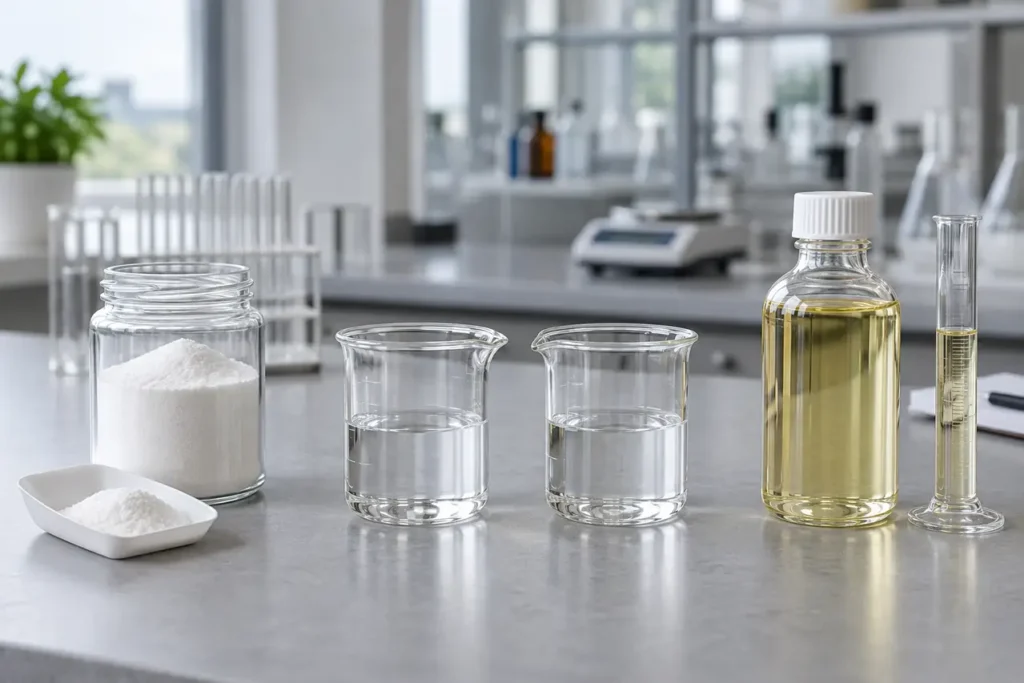
A request to replace Sodium Cocoyl Glutamate with Disodium Cocoyl Glutamate can hide two separate changes. The first is the salt form. The second is the form in which the supplier delivers the grade, such as a concentrated powder or a water-based liquid. Treating both changes as one is the reason simple one-for-one substitutions often produce misleading trial results.
The short answer is that Sodium Cocoyl Glutamate and Disodium Cocoyl Glutamate are not merely powder and liquid versions of the same commercial material. The names describe different neutralization states of the glutamate head group. Powder or liquid describes the supplied grade. A fair comparison therefore needs the complete INCI, declared composition, carrier water, physical form, test method, and finished-formula pH.
Separate the salt form from the supply form
Sodium Cocoyl Glutamate is the monosodium salt of N-coconut oil fatty-acid acyl derivatives of glutamic acid. Disodium Cocoyl Glutamate is the corresponding disodium salt. Both are used as cleansing surfactants, as recorded in the COSMILE Europe entry for Sodium Cocoyl Glutamate and its entry for Disodium Cocoyl Glutamate.
“Sodium” or “disodium” does not tell a formulator whether the purchased material is a powder, paste, or solution. It also does not state the concentration. Those details belong to the commercial grade rather than the INCI name. A liquid grade can contain water and more than one cocoyl glutamate salt, while a powder grade may be much more concentrated.
This distinction should also carry into purchasing records. If a request says only “Disodium Cocoyl Glutamate,” the buyer still needs the full composition and specification. Otherwise, two quotations may cover materials with different water contributions, handling requirements, and dosage calculations.
pH can shift the balance after the material enters the batch
Glutamic acid has two carboxyl groups. Their protonation state responds to the surrounding pH, so the distribution of more-protonated and more-deprotonated species can change after an N-acyl glutamate salt is dissolved and the finished formula is adjusted. The INCI on the raw-material label identifies what is supplied; it does not mean every molecule remains in one fixed ionic state throughout formulation.
Research on model N-acyl amino acid surfactant systems has shown that protonation and aggregation behavior are pH dependent. The published study on N-acyl glutamate and N-acyl aspartate systems helps explain why pH control matters. It is a mechanism reference, not a specification or performance prediction for a commercial cocoyl grade.
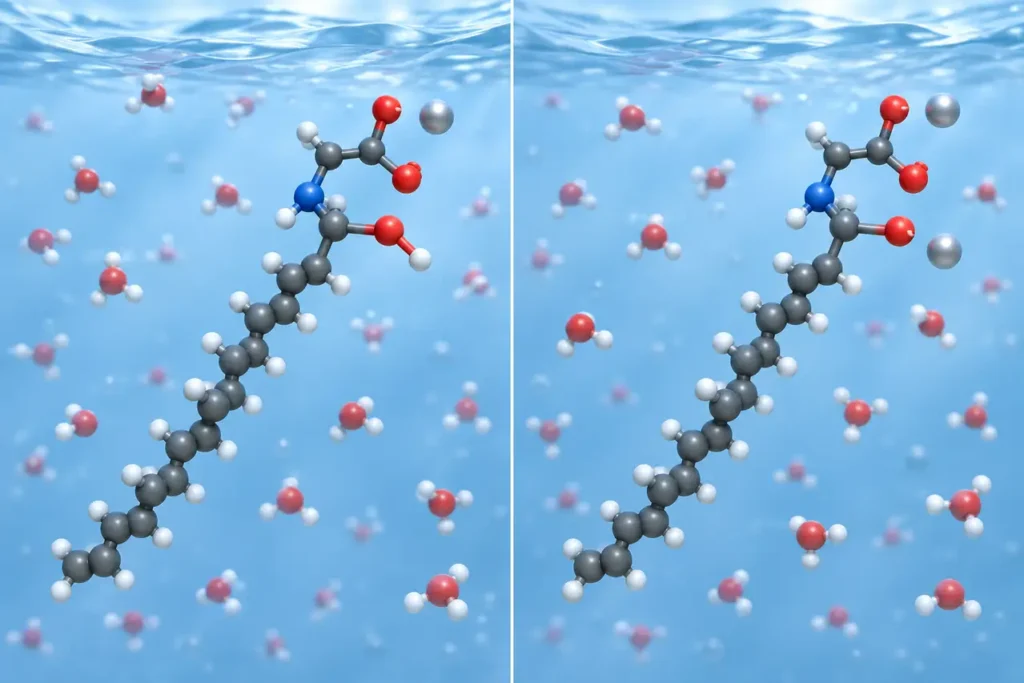
This is why a salt-form comparison cannot stop at the raw-material name. The formula’s final pH, buffer capacity, other surfactants, electrolytes, and processing history can all affect the observed system. It is reasonable to expect a formulation response when the supplied salt balance changes, but the direction and size of that response should be measured in the actual base.
Build a comparison on five fields
Before calculating a replacement, place both supplier documents side by side and check the following fields. This prevents a difference in carrier water or test definition from being mistaken for a salt-form effect.
| Field | Question to answer | Why it matters |
|---|---|---|
| Complete INCI | Is one salt listed, or is the grade a blend of water and multiple salts? | It defines what is actually introduced into the batch. |
| Declared content | Is the value composition, assay, active matter, solids, or another test result? | Values with different definitions should not be used as if they were equivalent. |
| Water or carrier | How much carrier enters with the raw material? | The formula water must be rebalanced during conversion. |
| Physical form | Does the plant need to disperse powder or meter a liquid? | Charge order, mixing time, dust control, and transfer equipment may change. |
| pH and test method | Are supplier values measured at the same concentration and temperature? | Numbers from unmatched methods can create a false comparison. |
If the documents do not define a number clearly, ask the supplier before calling it “active.” For an initial material balance, a declared ingredient-composition basis can still be useful, provided it is named accurately and kept separate from any method-based active-matter result.
Why a one-for-one raw-weight replacement fails
Suppose Grade A is a concentrated powder and Grade B is a 25 percent aqueous blend. Replacing 5 percent of Grade A with 5 percent of Grade B would sharply reduce the declared amount of cocoyl glutamate salts entering the formula. Any change in foam, viscosity, clarity, or pH could then come from the dosage error, the extra water, the changed salt balance, or all three.
A more useful starting calculation is:
Required raw material (%) = target declared cocoyl glutamate content (%) / grade's declared cocoyl glutamate fraction
This equation only normalizes the stated ingredient contribution. It does not establish functional equivalence between monosodium and disodium salts, and it does not replace bench testing.
Current comparison of INNO cocoyl glutamate grades
INNO currently offers KWCG-95 as a concentrated Sodium Cocoyl Glutamate powder and KWCG-25 as a water-based liquid containing both disodium and sodium salts. Their current listed details show why salt form and supply form need separate columns.
| Item | KWCG-95 | KWCG-25 | Conversion impact |
|---|---|---|---|
| Complete INCI or composition | Sodium Cocoyl Glutamate | 75% Aqua, 20% Disodium Cocoyl Glutamate, 5% Sodium Cocoyl Glutamate | KWCG-25 introduces two salt forms and carrier water. |
| Declared cocoyl glutamate content | 93.5% to 100% | 25% combined listed cocoyl glutamate salts | Raw-material weights cannot be compared directly. |
| Supply form | White solid powder | Pale-yellow or colorless transparent liquid | Dispersion and charging procedures differ. |
| Standard pack | 15 kg | 200 kg | Receiving, storage, and batch-size planning may differ. |
For a screening example, assume the target is 5 percent combined declared cocoyl glutamate content in the finished formula. KWCG-95 would be used at approximately 5.00 to 5.35 percent, depending on the applicable declared content within its listed range. KWCG-25 would be used at 20 percent because 20% multiplied by 25% equals 5%. That 20 percent addition would also bring 15 percent water into the batch.
This example is a material-balance starting point, not a recommendation that the two formulas will perform alike. It also does not convert the listed composition into a method-defined active-matter value. Current product documents and lot-specific quality records should govern purchasing and release decisions.
Run the conversion as an equal-basis trial

A useful replacement trial changes one decision at a time and records the basis. Begin with a small bench batch rather than a production-scale swap.
- Define the comparison basis. Record whether the calculation uses declared ingredient composition, supplier-defined active matter, or another documented value. Use the same basis for both grades.
- Rebalance the carrier water. Deduct the water supplied by the liquid grade from the formula’s added water. Keep the final batch size constant.
- Adapt the charging process. Establish a suitable wetting and dispersion step for powder, or a controlled metering step for liquid. Record temperature, mixing speed, addition order, and time.
- Set pH after the complete surfactant system is present. Measure under the same temperature and dilution conditions. Do not assume the raw-material salt name sets the finished-product pH.
- Compare finished samples under matched conditions. At minimum, record appearance, odor, pH, viscosity, foam behavior in the intended test, and stability results at defined time points.
If the surrounding surfactants, electrolyte level, fragrance, preservative system, or thickener also change, the trial can no longer isolate the effect of the cocoyl glutamate grade. Keep those variables fixed in the first comparison, then optimize the preferred route.
Which grade is the better starting point?
KWCG-95 is the more direct starting point when a concentrated powder fits the available formula water and the plant can handle powder dispersion. KWCG-25 is practical to evaluate when liquid charging is preferred and its 75 percent water contribution fits the product format. These are process and material-balance considerations, not proof that one salt form will deliver superior cleansing, foam, viscosity, or mildness in every formulation.
The final choice should follow the required product format, target pH, manufacturing equipment, composition declaration, and results from the same base formula. If the goal is substitution rather than a new formula, write the acceptance criteria before starting the trial so the decision does not depend on appearance alone.
Request a grade-to-grade assessment
INNO can review a current grade against KWCG-95 or KWCG-25 before you begin the conversion. Send the full INCI or supplier specification for the material now in use, its use level and calculation basis, the target product format and pH, the batch process, and the result you need to preserve. We can then prepare a clearer starting ratio and a focused validation checklist for your formulation trial.