A practical introduction for formulators and buyers evaluating this amino acid surfactant in powder form.
Sodium Cocoyl Glutamate often appears on a cleanser brief because the INCI is familiar and the ingredient is available in concentrated powder grades. That still leaves the formulator with a more useful question: what exactly will this grade add to the batch, and what work will it require?
The short answer is that Sodium Cocoyl Glutamate is an anionic cleansing surfactant based on coconut fatty-acid derivatives and glutamic acid. It can provide the surfactant portion of a rinse-off cleansing system, either alone or as part of a blend. Grade selection should start with the declared content, physical form, pH test method, accompanying water or salts, and the process available at the plant.
What the INCI name confirms
The INCI description identifies Sodium Cocoyl Glutamate as the monosodium salts of N-coconut oil fatty-acid acyl derivatives of L-glutamic acid. The “cocoyl” portion represents a coconut-derived fatty-acid distribution rather than one single chain length. The glutamate portion supplies the polar head of the surfactant.
This structure gives the molecule a water-compatible end and a fatty end that associates with oils and other surfactant tails. In water, those opposing affinities allow the material to collect at interfaces and form aggregates such as micelles. The COSMILE Europe ingredient database lists its cosmetic functions as cleansing and surfactant-cleansing.
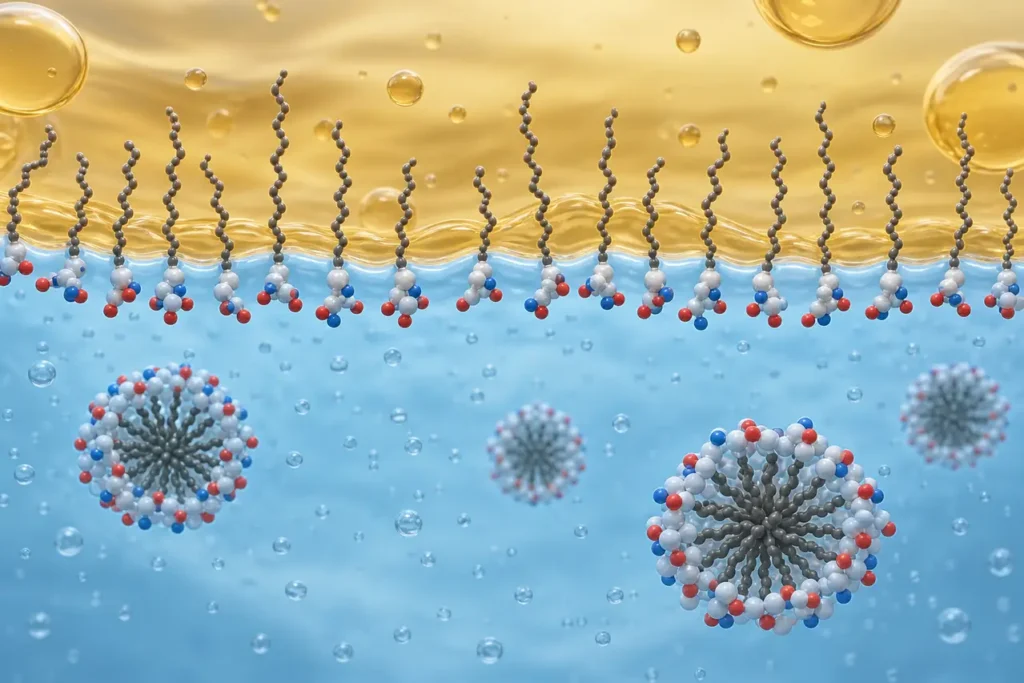
The name does not define the commercial format. Two products carrying this INCI may differ in supplied content, moisture, salts, appearance, particle behavior, and test methods. An INCI match confirms ingredient identity for a first screen. It does not make two supplier grades interchangeable.
Where Sodium Cocoyl Glutamate fits in a formula
Sodium Cocoyl Glutamate is mainly relevant to rinse-off products that need a cleansing surfactant. Typical development work includes facial cleansers, shampoos, body washes, hand washes, and other aqueous or concentrated cleansing formats. A powder grade may also be considered when the formulator wants to limit the water brought in by the raw material.
The ingredient name does not predict the finished foam, clarity, viscosity, or after-feel. Those results come from the complete surfactant system and the rest of the formula. Co-surfactants change aggregate structure. Fragrance and oils can disturb clarity or foam. Electrolytes and polymers can move viscosity in opposite directions depending on the system.
For that reason, evaluate KWCG-95 inside the intended base rather than in water alone. A water test can show whether the planned dispersion method is workable. Only the complete prototype can answer whether the grade suits the product.
Why powder form changes the development work
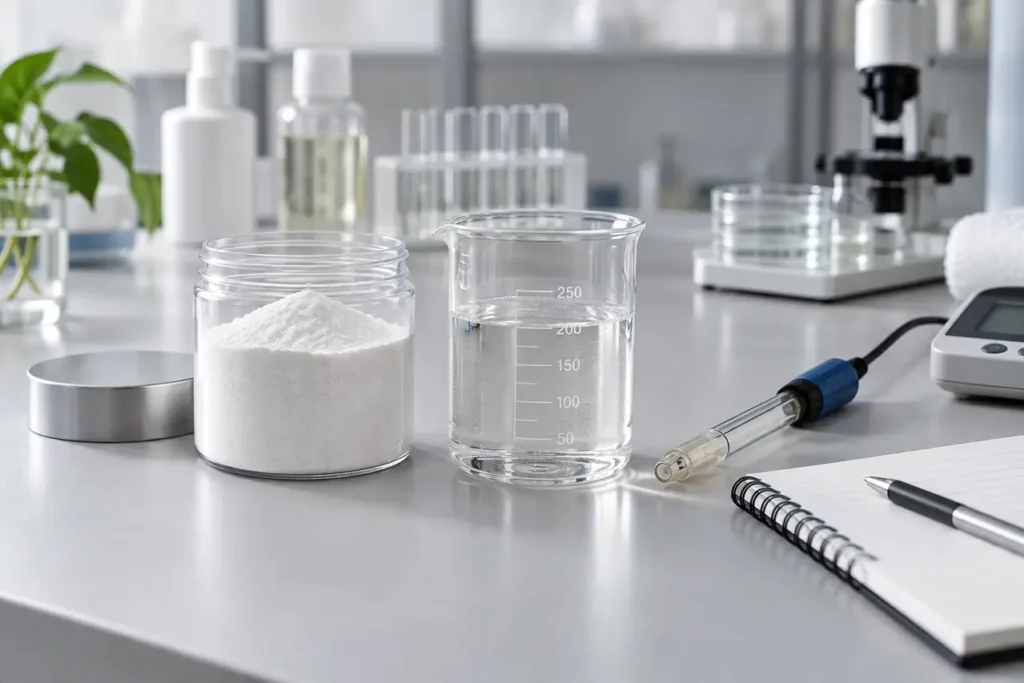
A concentrated powder gives the formulator direct control over the water balance. It may also reduce the volume of raw material needed for a given declared-content target. The practical cost is extra attention during charging and dispersion.
Powder added too quickly can form wet outer layers around dry material. Those pockets may survive normal mixing and appear later as visible specks or an inconsistent batch. The exact prevention method depends on the supplier’s process guidance and the available mixer, so the addition order should be established at bench scale before production instructions are written.
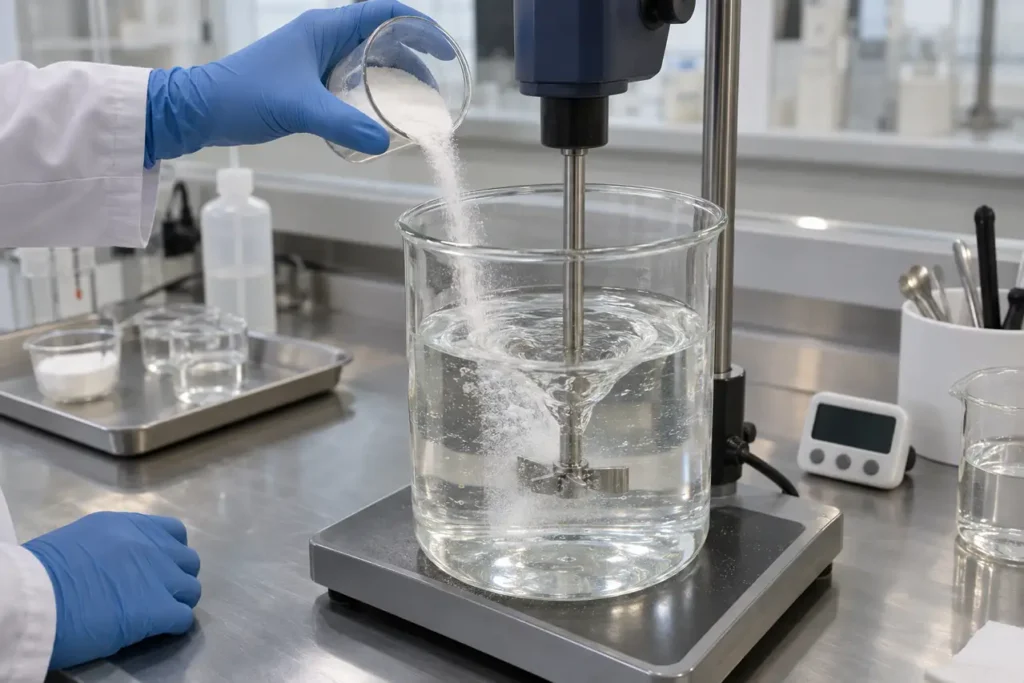
The plant review should cover weighing accuracy, dust control, charge rate, agitation, temperature, hydration time, and the point at which pH and viscosity are adjusted. A process that works in a small beaker may need a different charge rate or mixing time in a full vessel.
pH affects the surfactant state
Glutamate-based surfactants contain ionizable carboxyl groups. Changing pH changes the balance between protonated and ionized forms. This can influence solubility, aggregation, and the way the surfactant interacts with other ingredients.
Research on N-acyl glutamate surfactants has reported pH-dependent changes in protonation, micelle or vesicle structure, and interfacial behavior under the tested conditions. Those findings explain why pH deserves controlled testing. They do not establish a universal operating range for every commercial Sodium Cocoyl Glutamate grade or finished cleanser.
There are two pH values to keep separate. Raw-material pH belongs to a stated test dilution, temperature, and method. Finished-product pH belongs to the complete formula. A supplier value should be used for incoming comparison under the same method, not copied directly into the product brief as the target for the cleanser.
When screening a formula, set the pH after the main surfactant system is present and record when the measurement is taken. Recheck appearance and viscosity after adjustment. If the formula changes, the pH response may change with it.
How INNO supplies Sodium Cocoyl Glutamate
INNO currently offers Sodium Cocoyl Glutamate as KWCG-95, a concentrated white powder. Its current standard specification lists 93.5 to 100 percent content and CAS number 68187-32-6. The standard pack is 15 kg.
| Product code | KWCG-95 |
|---|---|
| INCI | Sodium Cocoyl Glutamate |
| CAS number | 68187-32-6 |
| Listed content | 93.5 to 100% |
| Appearance | White solid powder |
| Standard pack | 15 kg |
These fields answer the first purchasing questions, but the percentage still needs a definition. Before calculating a use level, confirm whether the supplier document reports assay, active matter, solids, or another content basis. Use the current TDS and specification for that calculation, then check the lot COA against the agreed purchasing limits.
A quick declared-content calculation
Once the percentage definition is confirmed, the first dosage estimate is straightforward:
Required raw material (%) = target declared-content basis (%) / supplied fraction
If a screening formula calls for 5 percent Sodium Cocoyl Glutamate on the same declared-content basis, a grade listed at 93.5 to 100 percent would require about 5.35 to 5.00 percent raw material. Use the actual specification value selected for the project rather than treating the range as a single number.
This calculation only normalizes quantity. It does not predict whether the formula will disperse, remain clear, build the intended viscosity, or meet its foam target. Those questions belong to the bench trial.
Read these specification fields before requesting a sample
A sample is most useful when the team already knows what it needs to prove. Review or request the following information first:
- The full INCI and CAS number for identity and labeling review.
- The definition and test method behind the declared content.
- Appearance, moisture or loss-on-drying limits, and any declared inorganic salts.
- The pH test concentration, temperature, and preparation method.
- Recommended charging, dispersion, and temperature guidance.
- The current TDS and SDS, followed by the lot COA when material is supplied.
For commercial comparison, convert each quotation to the same declared-content basis. A lower price per kilogram can be less attractive if the grade delivers less surfactant or requires a process the plant cannot run reliably.
When KWCG-95 is worth a bench trial
KWCG-95 is a sensible candidate when the project calls for Sodium Cocoyl Glutamate, a concentrated powder fits the water balance, and the site can manage powder addition. It is less useful to begin with the sample if the formula requires direct liquid metering or the production line has no workable powder-handling route.
Start with a small controlled comparison. Keep the base formula, production water, addition order, and evaluation method consistent. Record the actual content basis used in the dosage calculation, then assess the finished pH, appearance, viscosity, foam, and stability criteria relevant to the product.
To discuss a trial with INNO, send the product format, target finished pH, intended surfactant blend, batch process, and the result that will decide whether the grade advances. Request the current TDS, SDS, specification, COA format, and a KWCG-95 sample. That information is enough to turn a general ingredient inquiry into a useful bench plan.